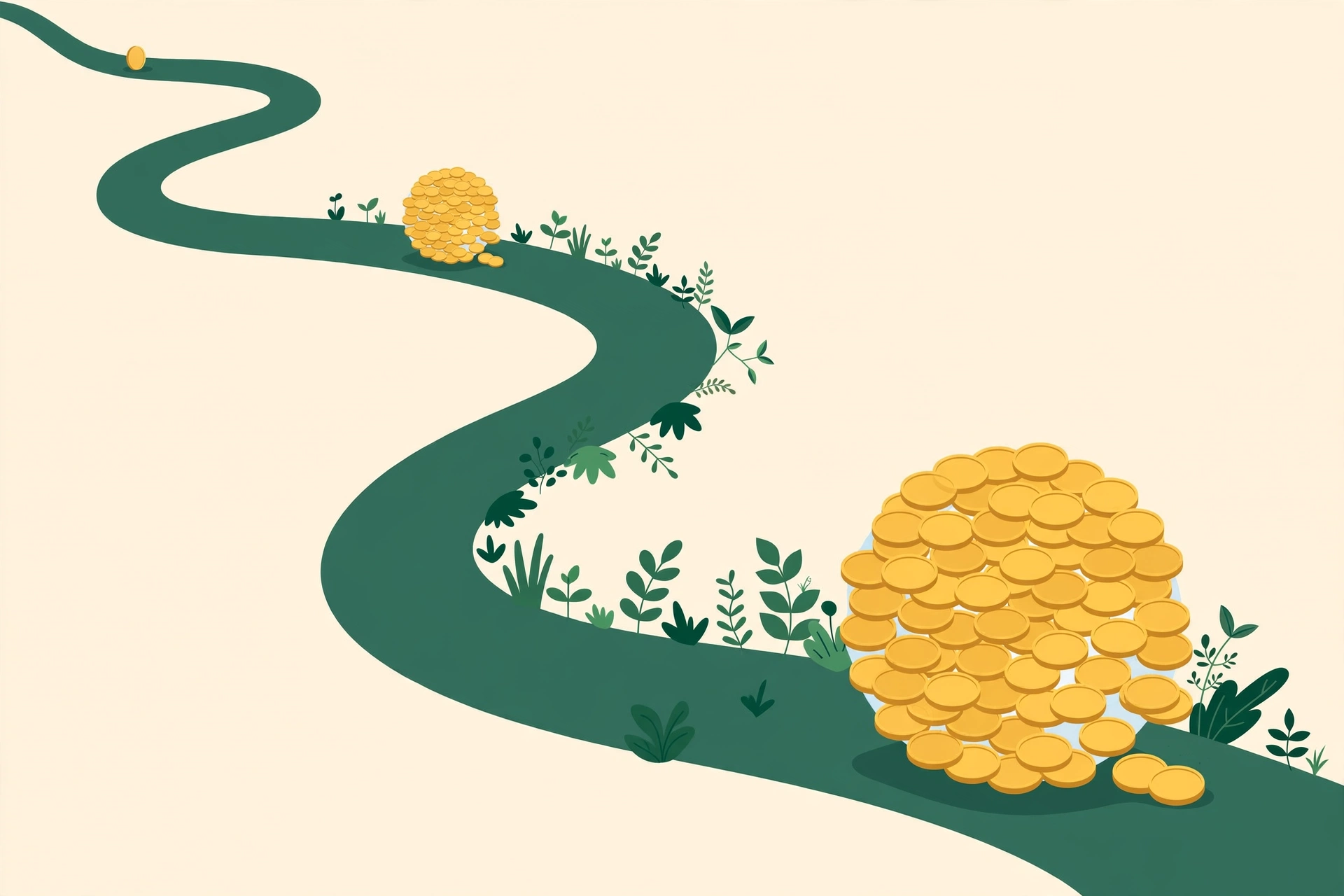
The idea in one sentence
With compound interest, you earn interest not just on your original money, but also on the interest you've already earned — so growth builds on growth, and the pace speeds up over time. Compare that with simple interest, where interest is only ever calculated on the original amount.
A worked example: $100 at an example rate of 10% a year
The numbers below are a maths illustration — 10% is chosen because it makes the sums easy to follow, not because any account or investment promises it. Real rates are lower or higher, change over time, and investments can fall in value. With that said, imagine $100 that grows at exactly 10% once a year, with the interest left in:
| End of year | Simple interest | Compound interest | What's happening |
|---|---|---|---|
| Start | $100 | $100 | The original amount |
| Year 1 | $110 | $110 | Both earn 10% of $100 = $10 |
| Year 2 | $120 | $121 | Compound earns 10% of $110 = $11 |
| Year 3 | $130 | $133 | Compound earns 10% of $121 ≈ $12 |
| Year 5 | $150 | $161 | The gap is widening |
| Year 10 | $200 | $259 | Compound is ahead by $59 |
| Year 20 | $300 | $673 | More than double the simple result |
The pattern to notice: in the early years compounding barely matters ($110 vs $110, $121 vs $120). The difference comes from time. Each year, the interest itself starts earning interest, and by year 20 the compound pot holds more from accumulated interest than from the original $100. This is why long-term goals like retirement saving are so sensitive to starting early: time in the system does more work than any single deposit.
Adding regularly beats starting big
Compounding gets stronger when you keep feeding it. As a second illustration at the same example rate: adding $10 a month to that $100 pot — $120 a year of ordinary, unglamorous transfers — produces a noticeably bigger result than the untouched $100 over the same years, because every deposit starts earning its own interest too. The start saving guide is about building exactly that habit.
The other direction: compounding against you
Compounding is neutral — it works on whatever balance it's pointed at. On a credit card balance, interest is charged on the balance including past interest, which is one reason card debt grows so stubbornly when only minimum payments are made. The full picture is in our guide to credit card APR; the short version is that the same maths that rewards savers over years quietly taxes borrowers over months.
Three honest caveats
- Real growth is never this smooth. Savings rates vary, and investment values move up and down — sometimes sharply. The tidy table above shows the mechanism, not a forecast.
- Inflation nibbles at the result. Money's buying power changes over time, so part of any interest earned is offset by rising prices. Growth figures are only meaningful with that in mind.
- Fees and taxes take their share. What you keep is what matters; costs reduce the balance that gets to compound.
See compounding's home turf: retirement accounts
What a 401(k) and an IRA are, how employer matching works, and Roth vs traditional — explained plainly.
Frequently asked questions
What is compound interest in simple terms?
Interest earned on both your original money and on the interest it has already earned. Because the pile that earns interest keeps growing, the growth speeds up over time — slowly at first, then noticeably.
What is the difference between simple and compound interest?
Simple interest is calculated only on the original amount, so it adds the same amount every period. Compound interest is calculated on the original amount plus all interest so far, so it adds a growing amount every period. Over 20 years at our example 10% rate, $100 becomes $300 with simple interest and $673 with compound interest — an illustration of the maths, not a promise about real returns.
Does compound interest guarantee my savings will grow?
No. The examples here use a fixed, made-up rate to show how the maths works. Real savings rates change, and invested money can fall in value. Nothing in this guide — or anywhere on this site — is a prediction or a promise of returns.
Why does starting early matter so much?
Because compounding's biggest ingredient is time. In the worked example, most of the compound advantage appears in the later years, as interest starts earning interest on a larger and larger pile. Money given 20 years to compound does far more than the same money given 10 — which is why long-term goals reward an early start more than a large one.
This guide is educational information, not financial advice. All growth figures are clearly labelled maths illustrations using a hypothetical rate; they are not predictions, and no returns are guaranteed anywhere on this site. See our Disclaimer.