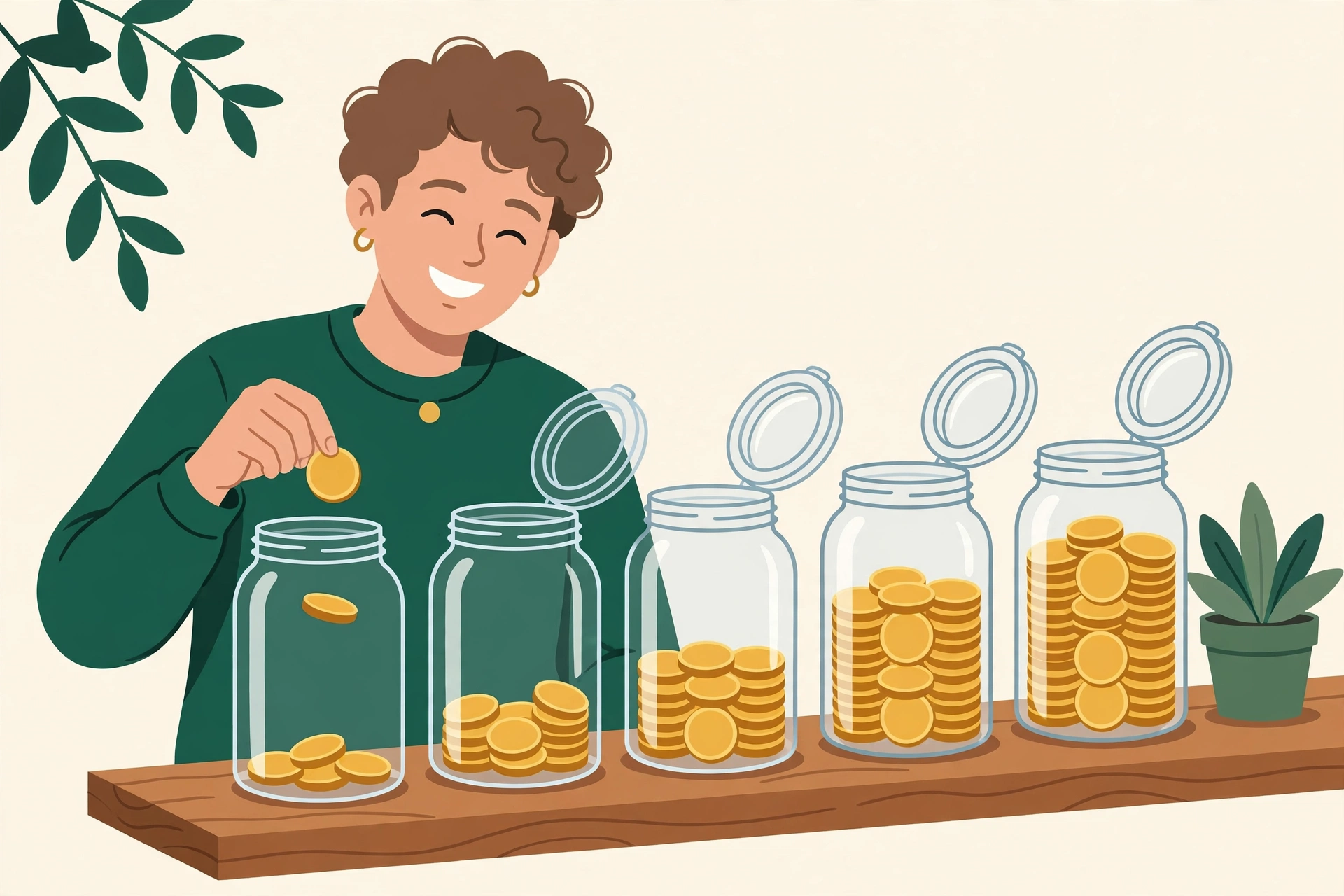
Saving is a system, not a salary level
If saving depended on income, everyone who got a raise would save more — yet many people earn twice what they once did and still save nothing. The difference is almost never the amount. It's the order of events. Money left in your everyday account “to be saved later” gets spent, because life presents a hundred small reasons to spend it. Money that moves to savings automatically, before spending starts, survives. This guide is about arranging that move — starting small, on whatever you earn now.
The first steps, in order
- Give your savings a job “Saving” in the abstract is easy to raid. Saving for something specific is much stickier. For most beginners the first job is an emergency fund — a starter cushion of $500–$1,000 so the next surprise doesn't go on a credit card. Later, each goal (a deposit, a trip, a car) can get its own named pot.
- Pay yourself first Treat savings like a bill you owe your future self: it leaves your account at the start, not with whatever is left at the end. “Leftover” saving fails because there's rarely anything left. Even $10 moved on payday is the habit working — the amount can grow later; the order matters now.
- Automate the transfer for the day after payday Set up a recurring transfer from your everyday account to a separate savings account, timed for the day after you're paid. Automation removes willpower from the equation: you don't decide monthly, notice it rarely, and adjust your spending to what's actually left without thinking about it.
- Start smaller than feels worthwhile The right starting amount is one you won't miss enough to cancel. $10 or $25 per payday sounds trivial — but it's $260 or $650 over a year of biweekly paydays, from a standing start, and it proves the system works. Small and permanent beats large and abandoned.
- Free up room one bill category at a time Don't overhaul your whole budget at once. Pick one category — subscriptions are the classic first target — trim it, and move the exact amount you freed into your automatic transfer. One category a month is a pace anyone can keep, and each small win makes the transfer grow. Our bill-lowering guide walks through the audit.
- Raise the amount when life gives you an opening A raise, a finished debt payment, a cancelled bill — each is a chance to increase the transfer before the money gets absorbed into everyday spending. Many people split every raise: half to lifestyle, half to the transfer. Your standard of living still rises, and so does your savings rate.
A worked example: from $0 to a starter fund
Meet Sam, a fictional example reader who takes home $2,400 a month and has never managed to save. Sam's plan uses only the steps above — no raise, no windfall:
| Month | What changed | Automatic transfer | Saved so far |
|---|---|---|---|
| 1 | First transfer set up: $25 per payday, the day after payday | $50/mo | $50 |
| 2 | Cancelled two unused subscriptions ($18/mo), added the amount to the transfer | $68/mo | $118 |
| 4 | Renegotiated internet bill, saving $15/mo — added to the transfer | $83/mo | $284 |
| 7 | Small raise arrives; half of it ($40/mo) goes to the transfer | $123/mo | $620 |
| 10 | Nothing new — the system just runs | $123/mo | $989 |
| 11 | Starter emergency fund goal reached | $123/mo | $1,112 |
Sam never saved a heroic amount in any single month, and never earned more than a modest raise. The whole result came from a small automatic transfer that grew four times by tiny, painless steps. That is the entire method — the numbers scale up or down with your income, but the shape stays the same.
Keep savings slightly out of reach
A separate savings account — ideally not the one your debit card draws from — adds just enough friction to stop casual dipping, while keeping the money reachable in a genuine emergency. Our guide to checking vs savings accounts explains how the two work together.
Your first savings goal: the emergency fund
How big should the starter cushion be, where should it live, and what counts as an emergency? The full guide.
Frequently asked questions
How much should I save from each paycheck?
Start with an amount you won't miss — even $10–$25 — and build from there. A common longer-term guideline is the savings share of the 50/30/20 rule (around 20% of take-home pay for savings and extra debt payments combined), but treat that as a direction to grow toward over months and years, not a starting requirement. The budgeting guide shows how it fits together.
Is it worth saving if I can only manage a tiny amount?
Yes, for two reasons. The money itself adds up — $25 a payday is roughly $650 a year. And the habit is the real asset: once an automatic transfer exists, raising it later is a two-minute change, and every raise or cancelled bill has somewhere obvious to go.
Should I save or pay off debt first?
A common staged approach: build a small starter emergency fund first so surprises don't add new debt, then focus extra money on high-interest debt, then grow savings again. The emergency fund guide and the debt payoff guide explain the reasoning on both sides.
Why do I keep dipping into my savings?
Usually because the money is too easy to reach and has no specific job. A separate account, an automatic transfer timed after payday, and a named goal (“car repairs”, “house deposit”) all add small friction that protects the pot. Dipping in for a genuine emergency is fine — that's what it's for; afterwards, rebuilding simply becomes the priority again.
This guide is educational information, not financial advice. Worked examples use fictional readers and round numbers to illustrate the maths. See our Disclaimer.